

Follow us
Elk News - the email newsletter
Subscribe to the Elk RSS feed, including blog posts, pictures and videos.
Titles only
Full content
Comments aren't included in these feeds. For them you can click the RSS icon in the Recent Comments box.
Our videos at
YouTube
Comments
lumi on poissa (?)
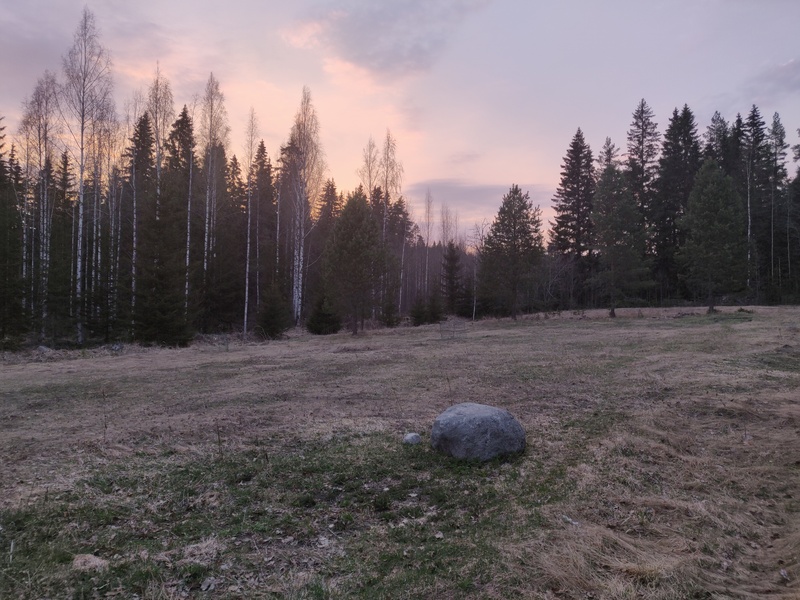
Yes! And as there has been these pictures of the snow gradually melting, I thought there might be a few more showing how the meadow gradually gets greener and greener, soon blossoming with flowers.
Your Finnish is grammatically correct and perfectly understandable. And in case you are interested in the nuances, I think in Finnish when we say "poissa" it has the connotation that you'd wish or expect something to be there but it is not. So "poissa" is something like missing, or absent. Referring to the snow I think we most commonly just say "sulanut" = melted. "Lumi on sulanut". But then it gets curiouser and curiouser =) As, for some reason the common idiom uses a plural form of snow. I'd guess the idea is something like "all of the snow". So, it would be "lumet ovat sulaneet", but in the spoken language we often say "lumet on sulannu" =)
Oh, I see! I was thinking something along the line of "gone (away) / no longer there/here", but "sulaa" makes sense too! Also talking about snow with the plural sounds very poetic to me since I'm used to romance and germanic languages always talking about in in the singular, but then it can be used in the plural to give a poetic connotation, a lot like saying "the winds" instead of "the wind" =) I don't know much finnish yet but it seems like a very logical language to me, a lot like japanese, but without the extra complication of chinese characters haha
More or less unrelated - but since the turn of the year I've had a subtle vague feeling of wanting to write about the philosophy of logic =) When we say "thing X is logical", what actually do we assume "logical" to be? Something which neatly follows a set of rules with minimal irregularities? Or something which has no, or very minimal, contradictions in the set of rules? Or, on a more broader sense - if it turns out that there are many ways to define what "logical" is, then how do we know which of the definitions is "true" or is it all down to a post-modernist "opinion"; are people totally free to pick which ever kind of "logical" they happen to like? Or can we establish some sort of "higher truth" about logic, something which is not altered by the randomness of the fashion of what this or that human being happens to favor?
Hehe, oh well. But back to Finnish grammar =) Yes, I think "lumi" is not a countable in Finnish. It wouldn't make sense to say "(1) yksi lumi", "(2) kaksi lunta", nor "(3) kolme lunta". Yet, we can use "lumet" in a plural. This might be logical, or not - depending on which kind of definition of "logic" one prefers =)
EDIT: hehe, seems like I got my html tags messed up in my first comment - which then caused all the following comments to be displayed in cursive. After a moment of confusion I figured it out and fixed the formatting of my comment.
Oh, yeah, haha. Here I was using using it as a shorthand for "easy to make sense of since it follows a predictable pattern".
Both Finnish and Japanese are (mainly) agglutinative languages, which means they work by adding extra bits, usually with single unique meanings, to words to add extra meaning to them, so you can end up with super-words that convey a lot of things through minimal and predictable changes, such as japanese "omoshirokunakatta" it wasn't interesting: composed of "omoshiroi" (interesting, which loses its -i adjective ending and gets -ku to make it glue-able to other words), "nai" (which is an adjective that exclusively forms negative words, and also loses its -i and gains a -ka to make it glue-able to other words) and -tta (an ending that puts words in the past, not only verbs, any words).
Another interesting and "logical" (as per defined) feature of those languages is being able to make new words out of already-existing ones, which can get quite creative. Take "tietokone" computer, "tieto" data, information, knowlegde (which itself seems to be a composite word, tietää + -o), and "kone" machine. All languages have this sort of thing, but agglutinative languages tend to have it to a much greater extent. The result is not always straight-up predictable from the root words, but usually the root words give a decent hint at what it means.
Both with Finnish and Japanese, people like to bring up that they're too complicated because they have lots of diverse dialects, colloquialisms, accents, etc, but I don't think that is a very good argument to say a language is "complicated" (as opposed to our definition of "logical"), as pretty much every language with that many million speakers will have those kind of things as well.
All of that can be contrasted (note that this is not a real contrast with some better/worse evaluation that exists in linguistics, but one I find in my own experience of speaking those languages and seeing people who speak languages of both groups comparing each other and reaching similar conclusions; those categories exist in linguistics mainly as a way of grouping similar things together) with the mainly fusional languages I'm used to, such as Icelandic, Portuguese or Spanish, which also work by adding and changing bits and pieces to root words, such as verbs, but these bits and pieces are much more fused together and much less predictable, which can make it hard to disentangle the meaning of a word. Take portuguese "comerias" you would eat, which is the verb "comer" to eat, conjugated on the conditional (also called "future of the preterite indicative") second person singular, which, for an -er ending verb, gives "-erias". It can be analised as the "-ia-" part making the conditional, and the "-s" part making the second person, but that doesn't give you much useful information on how to use another conjugation, such as "comias" you were eating, the same verb "comer", but conjugated on the preterite imperfect indicative second person singular, which also has an "-ia-", but that part here means the preterite, and an "-s", still meaning the second person. I know Finnish also has similar verb conjugations, but that's because such conjugation is a fusional characteristic of Finnish, and I think one can see the less predictable pattern here.
Modern English is another thing in itself, largely an "analytic" language, a lot like Mandarin Chinese, but it also still retains a degree of its earlier fusional/inflectional morphology. I would argue that English is also "simple", but maybe not so much "logical" like the agglutinative languages, but I'd rather not dwell into that hahaha =)
I think can see your goal with trying to comprehend what we mean when we say "logical" - I myself found a lot of pitfalls in my thought process trying to explain the differences I find between those languages I speak and why I find some more "logical" than others, so I first had to go and see what it is that makes one language more "logical" than another, to then get my definition of what a "logical language" means. If that is my opinion or some higher truth, I have absolutely no idea. I do believe, though, that linguistic paradigms do reflect how the human brain works as shaped by environment and culture (which itself could be considered a means of human interaction as a by-product of the environment where those interactions take place and took place in previous generations), so armed with that, one could have a starting point to get what "logical" means under various circumstances.
Edit: Ah yes, another thing, on absolute definitions vs opinion - I often find myself striving for absolute definitions of things, after all, it feels safe to have a solid foundation to stand on when defining one's worldview, goals, and so on. That does not mean, however, that I ascribe to certain ideologies and systems of belief that say that an "absolute ruler(s) of everything should exist, or else we would be deemed to endless chaos, so, please, follow my set of arbitrary rules which I happened to pick and choose according to my own taste from a larger set of arbitrary rules that was created more-or-less in the same pick-and-choose way a couple millennia ago". That also does not mean I'm not willing to compromise when absolute answers are not available, or when multiple complimentary or even contradictory answers do exist. After all, it is better to know that one's foundations are only so much strong, than to believe they are perfect and immutable, but the day a snow storm comes and snow piles up on the roof of one's neat little house, everything crumbles down, and then one acts surprised as to why such thing did happen - much like I often see people being angry at scientific research that contradicts earlier research which was deemed true for a(n arbitrarily) long time. So I guess my way of going about this is a lot like human languages, mainly one thing, but having bits and pieces of almost every other paradigm.
Often my friends press me for my opinion of certain matters, speculating about what would and would not be, what should and should not be, and often I cannot give an answer. There are facts I know, there is only so much I know about those facts and how reliable they are, there is my often-limited understanding of these facts and the situation, and often there are similar past events which could give an idea of towards where things are headed. When I find myself reasoning like that, I know it is because something is lacking in my knowledge and/or judgement, so I don't have the least desire to speculate about it. This is not because I feel like I'm somehow better than others if I take a neutral stance, it is just that I don't find it very satisfying to spend a lot of time speculating about how the world is and should be, how it is and could be, and then after the discussion is over, I find that neither the world's state nor anyone's opinions have changed in the least, and that is rather disappointing to me. At these times I just find myself watching things unfold until comes a point I go "aha, now I think I've seen something similar, so I guess I know where this is headed, even if it is only in this given domain".
Sure, I do have lots of opinions about lots of things, but they don't hold as much value to me as the things I know with so much certainty. After all, no mater how emphatic I can be about certain opinions I have, they're nothing but opinions, and are usually the first thing to go away when I find a better way to interpret reality - or that now I feel like listening to noisy and loud music when just the other day I was complaining about it =)
PS: I've always loved that we can have such conversations here in the comments of your blog - this is about the opposite of what I was talking about with a friend earlier today - I'd like to write as much as this reply on a tweet, but that's not possible, and the alternatives usually are: to make it span a hundred tweets which would be cumbersome to read and no one would pay attention, or to distill one's thoughts to their bare essentials, which usually also means going through the easiest route and making things as incisive and idiotic as possible. I can't change twitter with that opinion, but I can definitely change the means by which I write about things to share with others =)
Add new comment